

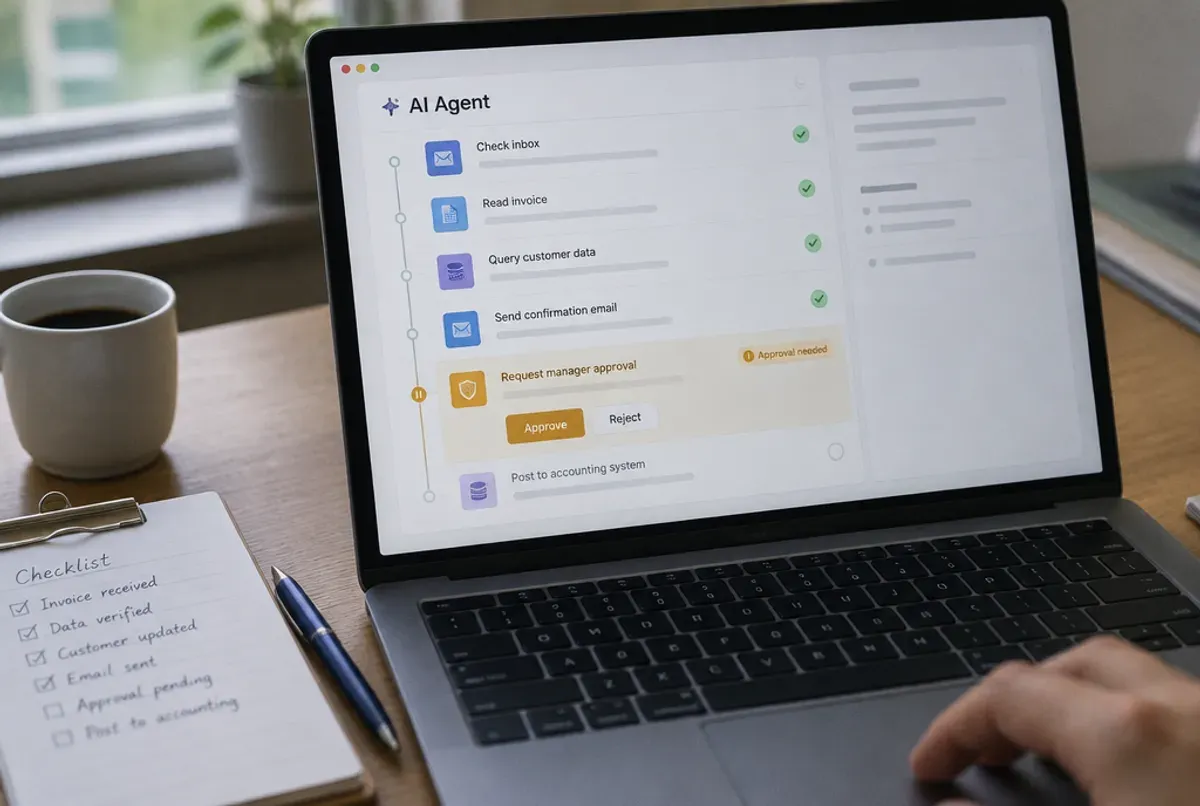
An AI agent makes costly mistakes when nothing limits what it can touch or checks its work. Putti, an Auckland AI agent developer, stops that with four controls: narrow permissions, human sign-off on risky actions, testing against real cases from your business, and a full log of every action.
Why does an AI agent sound sure when it's wrong?
The model behind an agent produces answers that read well, and it can't reliably tell you when one is wrong. That's the uncomfortable bit. An agent that's right nine times out of ten isn't a nine out of ten problem. It's a problem with the tenth, because the tenth arrives in the same calm tone as the other nine, and it might be a quote, a contract clause or a reply to a customer.
Putti's team talked through exactly this on Launch Time, our video series: an AI can be wrong 10 percent of the time and not know it. So the safety gets built around the model, not left to it.
What should an AI agent be allowed to touch?
Only what its job needs, and nothing more. An agent that drafts supplier refunds shouldn't have the permission to send them. An agent that reads invoices shouldn't be able to edit the ledger. Scoping access this narrowly is dull work, and it's the single biggest reason a mistake stays small.
It also keeps your data tighter. When each agent can only reach the records it needs, a bad run can only damage so much.
Which actions should wait for a person?
Anything that's hard to undo. Payments, messages that go out to customers and the deletion of records are the three we put behind a human checkpoint every time. The agent prepares the work, lays out what it plans to do and why, and a staff member approves it.
This doesn't slow the work down as much as people expect. The agent still does the reading, matching and drafting that eat the hours. The person only spends a few seconds on the final click, and only on the actions that carry real risk.
How do you test an agent before it goes live?
Against your real cases, not a demo script. We build a test set from past work in your business, with the right answers already known, and we deliberately include the awkward ones. A supplier who emails from a personal address. A customer who writes three requests in one message. A spreadsheet where the same column has been filled in four different ways.
The agent gets measured against that set before launch and again after every change. When it misses something that matters, the miss becomes a new test. Over a few weeks the set turns into a record of everything that has ever gone wrong, and the same mistake can't quietly come back.
What should the audit trail show?
Every action the agent took, the record it touched and the information it used to decide. You should be able to open the log on a Monday morning and see why a thing happened, not only that it did. There's also an off-switch, so if an agent starts behaving oddly you can stop it in one click rather than raising a ticket.
If a vendor can't show you that trail, ask harder questions. A demo that looks good is easy to build. A system you can audit is much harder, and it's the part that matters once real money is involved.
What if someone else already built the agent?
Fixable, usually. Plenty of AI prototypes behave well in a demo and misbehave the moment real data arrives. We review how it's put together, from the prompts and data sources to the permissions it holds, then add the guardrails, tests and logging that are missing. If one part can't be made reliable, we'll tell you straight and rebuild only that part. Our post on what an AI agent actually is is a useful starting point if you're sizing up a prototype, and the comparison of custom agents against off-the-shelf tools helps you decide what to keep.
Talk to Putti about a safe agent
Putti has delivered 100+ projects since 2010 with zero failures for clients including Spark, Hilton and Fletcher Building, and we build AI agents the same way, with the safeguards designed in from the first week. Property Writer AI is one example: it drafts listing copy and flyers in seconds, and the real-estate agent can edit the draft before anything is published. If you're planning an agent, or you've inherited one that makes you nervous, talk to us. You can also read how we approach AI agents for NZ businesses.