
The Real Question Companies Should Be Asking
- Which model should we use?
- Which platform should we buy?
- Which vendor is best?
- How do humans and AI work together within our organisation?
The Four Ways Organisations Build AI Capability
1. Build internal capability
2. Hire external specialists
3. Use consultants and fractional expertise
- AI strategy definition
- System and workflow audits
- Architecture and governance design
- Knowledge transfer to internal teams
4. Deploy AI agents as digital workers
- Automated research and analysis agents
- Customer support and operations agents
- Internal workflow orchestration agents
Balance Matters More Than Any Single Approach
- Too much reliance on AI agents without internal understanding creates fragile systems.
- Too much consulting without internal ownership leads to dependence.
- Too much hiring without clarity leads to high cost and low impact.
AI Forces a Redesign of Roles, Not Simply Tools
- Judgement and decision making
- Creative problem solving
- Context setting and prioritisation
- Supervision and responsibility
AI Transformation Is a Leadership Problem
- Which decisions are we comfortable delegating to AI?
- Where do humans remain accountable?
- How do we measure productivity in hybrid human-AI teams?
The Bottom Line
Failure occurs when organisations do not redesign how work is performed.
The advantage will go to organisations that learn to work effectively with AI, not just purchase it.
Frequently Asked Questions: AI and the Future of the Workforce
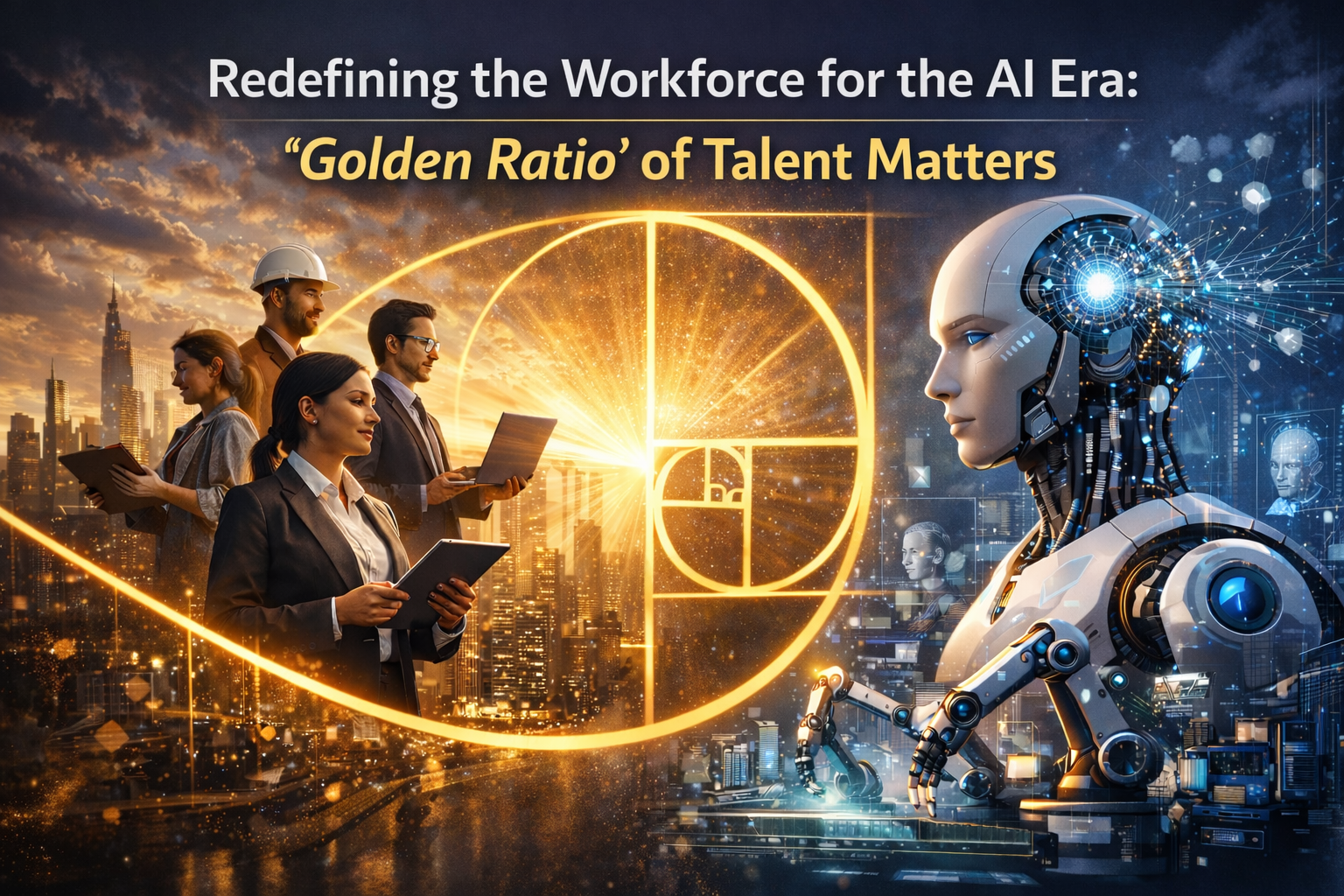
What is the “Golden Ratio” of talent in the AI era?
The Golden Ratio of talent in the AI era refers to the optimal balance between human expertise and AI capability in a workforce. It recognises that AI performs best at repetitive, data-intensive, and pattern-matching tasks, while humans excel at judgement, creativity, relationship-building, and ethical reasoning. Organisations that find this balance — automating the appropriate work with AI while investing in human capabilities — outperform those that either ignore AI or over-automate without regard for human value.
Will AI replace jobs in New Zealand?
AI will change many jobs in New Zealand, but outright replacement is less common than transformation. Most studies suggest AI will eliminate some routine tasks while creating new roles focused on AI management, oversight, and higher-level judgment. The businesses managing this transition well are those that use AI to handle repetitive work, freeing staff for higher-value activities, rather than simply cutting headcount.
How should New Zealand businesses prepare their workforce for AI?
NZ businesses should: audit which tasks in each role are most automatable, identify AI tools that can handle those tasks, train staff in AI literacy so they can work effectively alongside AI tools, and create clear policies around AI use and accountability. The goal is to make each person more productive and more valuable — not to reduce the team.
What skills will matter most for workers in an AI-augmented workplace?
In an AI-augmented workplace, the most valuable skills are those AI cannot easily replicate: critical thinking, ethical judgment, creative problem-solving, communication, relationship management, and domain expertise. Technical AI literacy — knowing how to use AI tools effectively and how to evaluate AI outputs — will also become a core competency across most professional roles.