
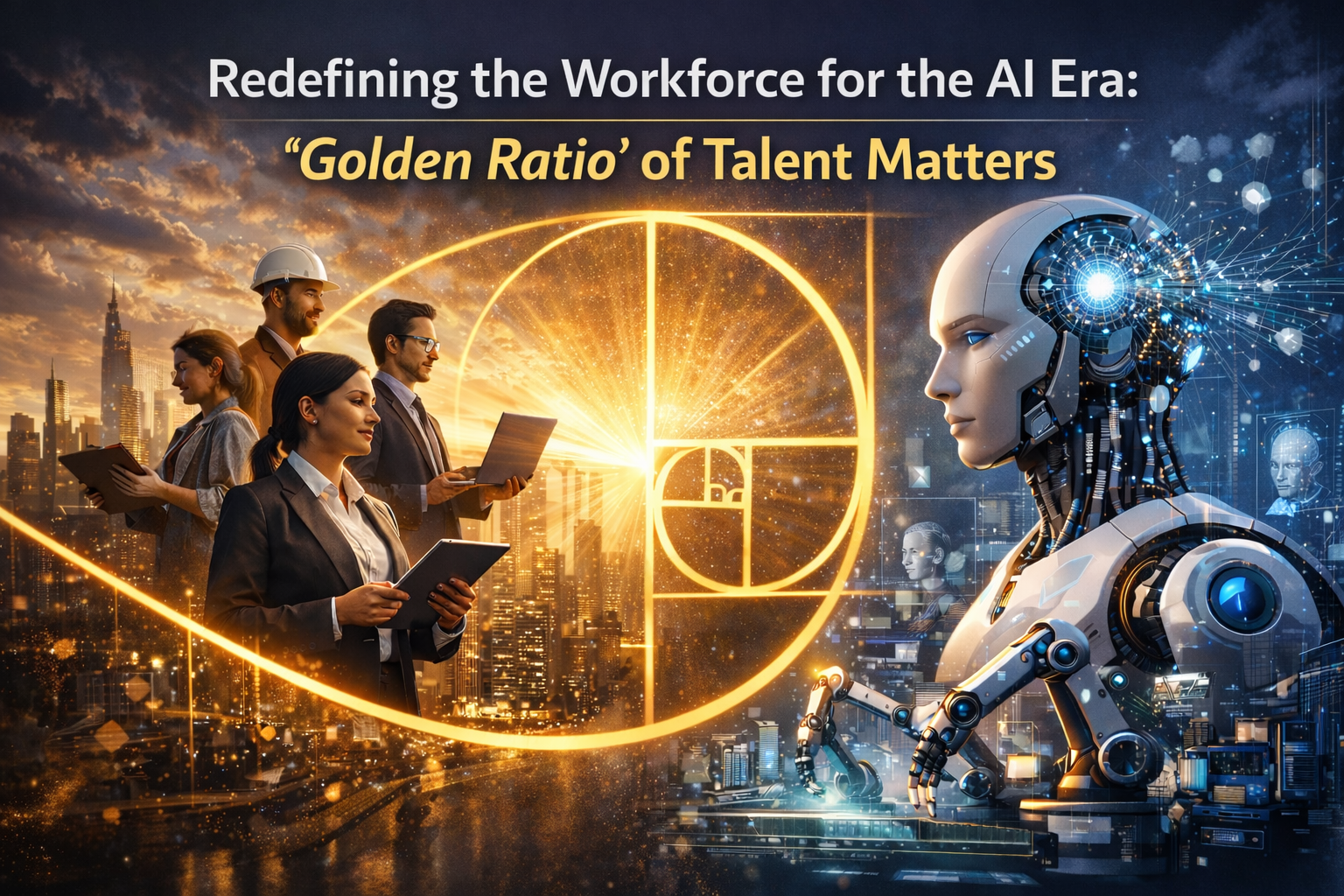
AI is no longer experimental; it is embedded in products, workflows, and decision-making across industries. Despite record investment in AI tools and applications, many organisations are still struggling to see meaningful returns.
The underlying reason is clear.
AI success depends less on technology and more on effective work design and joint effort between people and systems.
A recent industry discussion shows a critical shift that many leaders are just beginning to understand. AI adoption often fails when approached as a software rollout, but succeeds when viewed as a workforce redesign.
The Real Question Companies Should Be Asking
Most discussions about AI begin with a focus on tools.
- Which model should we use?
- Which platform should we buy?
- Which vendor is best?
Those questions matter, but they are secondary.
A more important question is:
- How do humans and AI work together within our organisation?
Answering this requires rethinking talent strategy, capability ownership, and workflow throughout the business.
The Four Ways Organisations Build AI Capability
A workable framework emerging from recent AI adoption highlights four key sources of capability that organisations rely on.
1. Build internal capability
This involves upskilling existing teams. Engineers, analysts, product managers, and operations staff learn to work with AI systems as part of their primary duties.
This approach is effective because internal teams already understand the commercial setting. As they develop AI literacy, adoption becomes practical rather than theoretical.
Building internal capability promotes long-term resilience, though it requires time and leadership commitment.
2. Hire external specialists
Some skills cannot be developed quickly enough internally. AI architecture and production-scale deployment require experienced specialists.
Hiring external specialists offers speed and expertise, but also presents trade-offs. These roles are costly and scarce, and without proper integration, they may become isolated from the organisation.
Hiring is most effective when it addresses specific gaps rather than serving as a universal solution.
3. Use consultants and fractional expertise
Many organisations undervalue short-term, high-impact expertise.
Consultants and fractional specialists are especially effective for:
- AI strategy definition
- System and workflow audits
- Architecture and governance design
- Knowledge transfer to internal teams
This technique reduces early risk and helps teams avoid costly errors. It is important to ensure that knowledge is transferred internally rather than remaining reliant on external dependencies.
4. Deploy AI agents as digital workers
At this stage, the conversation shifts.
AI agents are no longer passive tools. They carry out tasks, coordinate workflows, and operate across systems, effectively functioning as digital team members.
Examples include:
- Automated research and analysis agents
- Customer support and operations agents
- Internal workflow orchestration agents
Organisations achieving the greatest gains are not only using AI to assist humans, but are also deliberately assigning work to AI agents as part of the workforce.
Balance Matters More Than Any Single Approach
No single approach is effective in isolation.
- Too much reliance on AI agents without internal understanding creates fragile systems.
- Too much consulting without internal ownership leads to dependence.
- Too much hiring without clarity leads to high cost and low impact.
Successful organisations find a balance that corresponds to their size, maturity, and risk threshold. Balance is not fixed. It evolves as the organisation grows and as AI becomes more deeply embedded into everyday work.
AI Forces a Redesign of Roles, Not Simply Tools
One of the most underestimated impacts of AI is its ability to reshape human roles.
As AI takes on more execution and coordination tasks, human work shifts toward:
- Judgement and decision making
- Creative problem solving
- Context setting and prioritisation
- Supervision and responsibility
This shift isn’t about replacing people, but about reallocating human effort to areas where it creates the most value.
This transition demands intentional role design. Without it, AI may add unnecessary complexity.
AI Transformation Is a Leadership Problem
AI adoption spans technology, operations, HR, and strategy, so it cannot be managed solely by engineering or IT.
Leadership teams must answer questions such as:
- Which decisions are we comfortable delegating to AI?
- Where do humans remain accountable?
- How do we measure productivity in hybrid human-AI teams?
Organisations that avoid these questions often stall, while those that address them early progress more quickly and confidently.
The Bottom Line
AI does not fail because the models are weak.
Failure occurs when organisations do not redesign how work is performed.
Failure occurs when organisations do not redesign how work is performed.
The companies that win with AI treat it as a workforce-design challenge, not a tool-selection exercise. They intentionally combine internal capability, external expertise, and AI agents into a coherent operating model.
AI is here to stay.
The advantage will go to organisations that learn to work effectively with AI, not just purchase it.
The advantage will go to organisations that learn to work effectively with AI, not just purchase it.